research
Deceptron / D-IPG
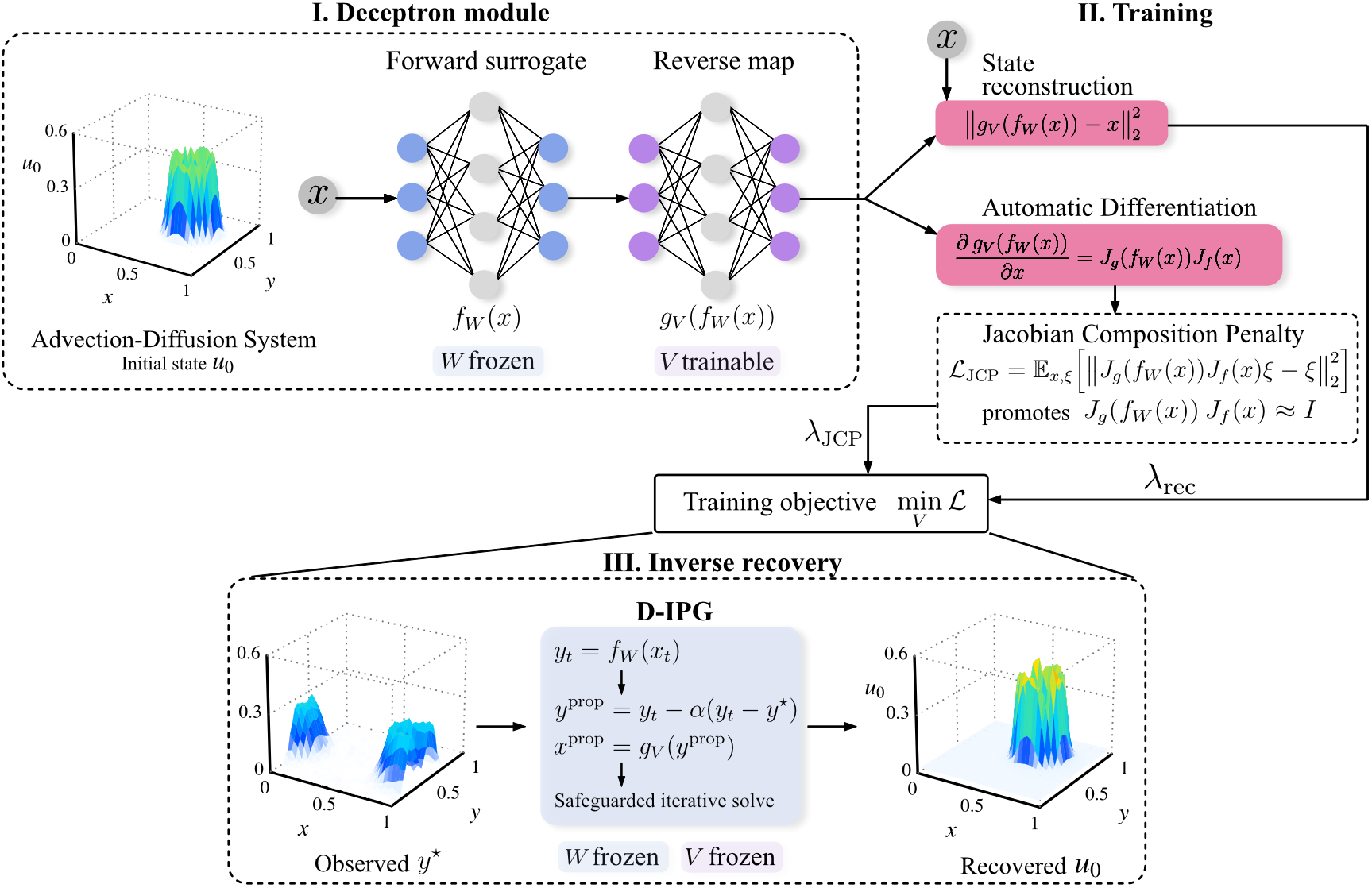
Suppose we observe a concentration field after it has been transported and diffused, and want to recover the initial field. A forward surrogate predicts the later field from a candidate initial state. Deceptron pairs it with a learned reverse map. For iterative recovery, the reverse map needs to do more than reconstruct training examples: it needs to turn small changes in the predicted field into useful changes in the initial state.
The Jacobian Composition Penalty (JCP) trains that local response. A small perturbation to the initial state is pushed through the forward derivative and then pulled back through the reverse derivative. The penalty encourages the round trip to recover the original perturbation. During recovery, D-IPG moves the predicted field partway toward the observation, then uses the reverse map to turn that proposal into a candidate initial state. The solver repeats this process with the trained maps fixed.
Component-Access Subspace Optimization (CASO)
A physics-informed model may be trained to satisfy a governing equation, initial conditions, and boundary conditions at the same time. These requirements enter training as separate loss terms, but the optimizer acts on their aggregate. CASO investigates how information from the individual terms can inform optimization of that aggregate objective.